At a glance
Key points
- Without further action, England could face a public water supply deficit of up to five billion litres a day by 2055; the national estimate does not include emerging demand from data centres.[1]
- A data centre’s water demand depends heavily on its cooling technology, operating conditions and location. A single national consumption figure would obscure those differences.[2][4]
- Nine proposed reservoirs could add about 670 million litres a day by 2050 — valuable capacity, but a fraction of the projected national gap.[5]
- Policy should test power, water, wastewater, drought resilience and community benefit together before consent is granted, then require operators to report actual use.[2][3][4]
Evidence
The water gap is already measured in billions of litres
The policy problem begins before a new data centre turns on. The Environment Agency’s 2025 national framework says that, without action, England could face a public water supply deficit of up to 5,000 megalitres — five billion litres — each day by 2055. The estimate combines pressures from population growth, climate change, environmental protection and stronger drought resilience. Demand outside the public supply system could add a further 1,200 megalitres a day by the 2050s.[1]
There is an important qualification. The Environment Agency says its national forecasts do not include new or emerging non-public demands from data centres or low-carbon energy. In other words, the headline gap is not a forecast of what AI will consume. It is the difficult starting position into which AI infrastructure is being invited.[1]
The regional picture is uneven. The same framework estimates that the South East may need more than two billion additional litres a day for public supply between 2030 and 2055, while the eastern region faces pressure from public supply, agriculture and power generation. A national total therefore cannot tell a planner whether one proposed campus has a secure and environmentally sustainable local supply.[1]
Evidence
Data centres make a local constraint sharper
Data centres are now designated as critical national infrastructure. They store and process the information behind public services, business systems, cloud computing and AI. Their cooling systems can also require substantial quantities of water, but there is no honest universal figure for a ‘data centre’. Demand varies with the computing equipment, the weather, the cooling design, the source of the water and how much is recirculated.[2][4]
The Environment Agency distinguishes open systems from more efficient closed-loop systems and notes the growth of direct-to-chip liquid cooling. It also records that some water companies have already refused data-centre applications, and that abstraction is not available in every catchment. Recycled water, collaboration with other users and closed-loop designs are therefore not decorative sustainability pledges; in some places they may determine whether a proposal is viable at all.[2]
Government already recognises the constraint in its AI Growth Zone criteria. Applicants must show sufficient water for at least 500 megawatts of AI infrastructure and provide written confirmation from the local supplier covering volumes, constraints, infrastructure and delivery times. They must also explain how wastewater will be managed. The principle is sound: water should be evidenced, not assumed.[3]
Evidence
Reservoir construction is returning, but slowly
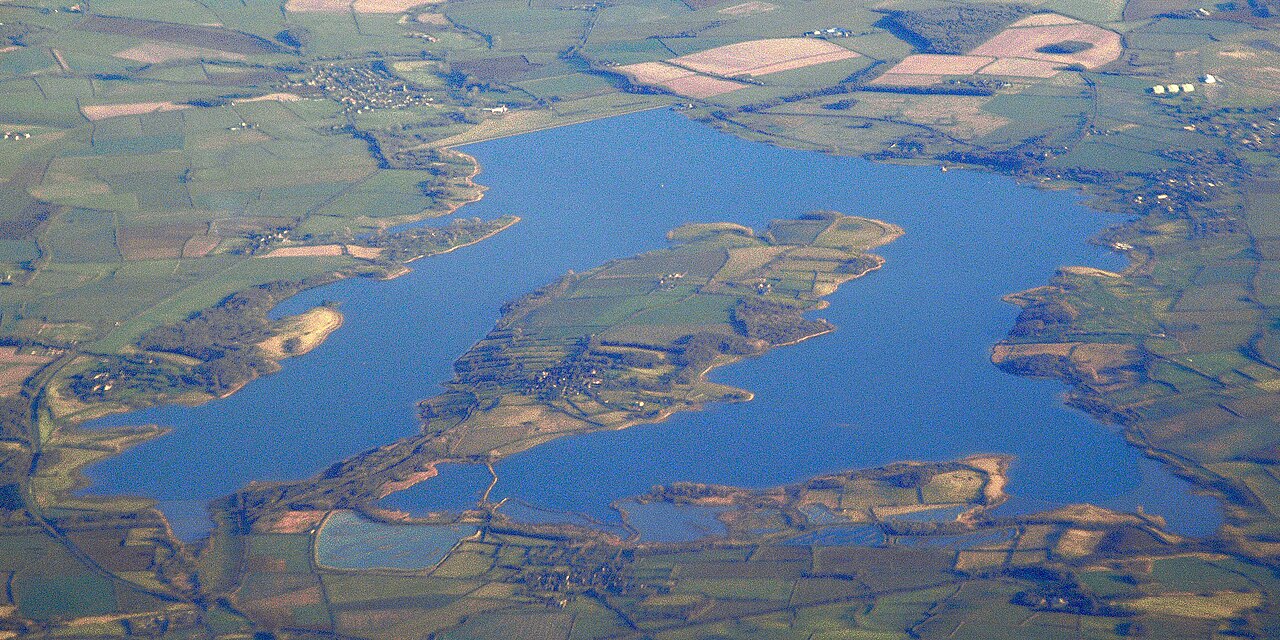
England is planning major new storage after decades without a new large reservoir. Water companies have committed to nine reservoirs by 2050. Government estimates that they could provide about 670 million litres a day between them; proposed schemes in Lincolnshire and the Fens account for up to 166 million and 87 million litres a day respectively.[5]
That is significant infrastructure, but it is not enough to erase a possible five-billion-litre public supply gap on its own. Reservoirs must also be filled, connected and operated within river-flow and environmental limits. They take years to plan and build, require land and finance, and can move water across time more readily than they create a new annual supply.[1][5]
Recent drought conditions show why resilience matters. In August 2026 the Environment Agency reported reservoir storage in England at 69 per cent, 11.6 percentage points below the seasonal expectation, after the largest July reduction in raw storage for at least 30 years. That was a snapshot during an exceptional dry period, not a permanent condition, but it exposes the cost of running a system with too little margin.[6]
Understanding
The wrong question produces the wrong argument
It is tempting to reduce the debate to a choice: either build reservoirs for homes and farms, or use scarce water for AI. That framing conceals the real policy work. Water availability is local, technology choices can alter consumption, and different uses have different social and economic value. A closed-loop facility using reclaimed water in a water-secure area is not equivalent to an evaporatively cooled campus seeking drinking-quality supply in a stressed catchment.
Nor should the uncertainty be used to pretend there is no problem. The House of Commons Library notes that UK data-centre water information remains limited and difficult to compare. Without standard reporting, public bodies cannot reliably judge promised efficiency against actual performance, and communities are asked to accept assurances that cannot be tested.[4]
Reservoirs remain part of a credible response because they can store high winter flows for later use and improve drought resilience. But the arithmetic shows why supply construction must sit beside leakage reduction, household and business efficiency, transfers, recycling and environmental restoration. The choice is a portfolio, not a single concrete structure.[1][5][7]
Options
Four choices for a water-aware AI policy
First, make water a binding spatial-planning test. A data-centre proposal should identify its maximum and expected demand, source, drought-year operation, discharge route and effect on other users before a site is designated. The AI Growth Zone process asks for much of this evidence; the same discipline should apply consistently beyond the zones.[3]
Second, regulate outcomes while allowing technology to change. Planning conditions and supply contracts can set limits for potable-water use, require closed-loop or reclaimed-water options to be assessed, and trigger curtailment arrangements during drought. A fixed list of favoured cooling equipment would date quickly; a transparent water budget can remain useful as hardware evolves.[2]
Third, coordinate infrastructure rather than approving each network in isolation. Reservoirs, transfers, wastewater recycling, grid connections and data centres have different lead times. Regional plans should show when capacity will genuinely exist, who pays for it and which users bear the risk if growth arrives first.[1][5]
Fourth, require comparable operational disclosure. Operators should publish annual withdrawal and consumption, the proportion that is potable or reclaimed, peak-day demand and performance in water-stressed periods. Commercially sensitive detail can be protected without hiding the information needed for public planning. The lack of consistent UK data is itself a policy gap.[4]
Next steps
Build the water budget before promising the growth
The immediate task is not to set an arbitrary national cap on data centres. It is to make every major proposal pass the same auditable test: is the water physically available in this catchment, in a dry year, after homes, food production and the environment are protected? If the answer depends on a new reservoir, transfer or recycling plant, consent should be tied to the delivery of that infrastructure rather than to an aspiration that it will appear later.
Government should also publish a national method for data-centre water reporting and use the results to update regional water plans. That would replace competing anecdotes with evidence and reveal where efficient design is working. The Environment Agency has already identified the need to understand the sector and assess reuse and closed-loop options; the next step is to turn that intention into a common requirement.[2]
England needs more water infrastructure, and the return of reservoir construction is welcome. But reservoirs cannot serve as a permission slip for unlimited demand. The durable policy is to choose locations and technologies that fit the water system, then invest in storage, transfers, leakage reduction and reuse as one connected programme. AI growth will be more credible when the water underneath it has been planned with equal seriousness.
Sources and references
- 1Environment Agency. National Framework for Water Resources 2025: how much additional water we need, GOV.UK (2025). View original source ↗
- 2Environment Agency. National Framework for Water Resources 2025: water for data centres and artificial intelligence, GOV.UK (2025). View original source ↗
- 3Department for Science, Innovation and Technology. AI Growth Zones: open for applications, GOV.UK (2026). View original source ↗
- 4Adam Clark, Nuala Burnett, Iona Stewart and John Woodhouse. Data centres: planning policy, sustainability, and resilience, House of Commons Library (2026). View original source ↗
- 5Department for Environment, Food & Rural Affairs. Government steps in to build first major reservoirs in 30 years, GOV.UK (2025). View original source ↗
- 6Environment Agency. More areas in England declared in drought after record dry July, GOV.UK (2026). View original source ↗
- 7Ofwat. RAPID: securing customers’ future water supplies in AMP8 (2025). View original source ↗